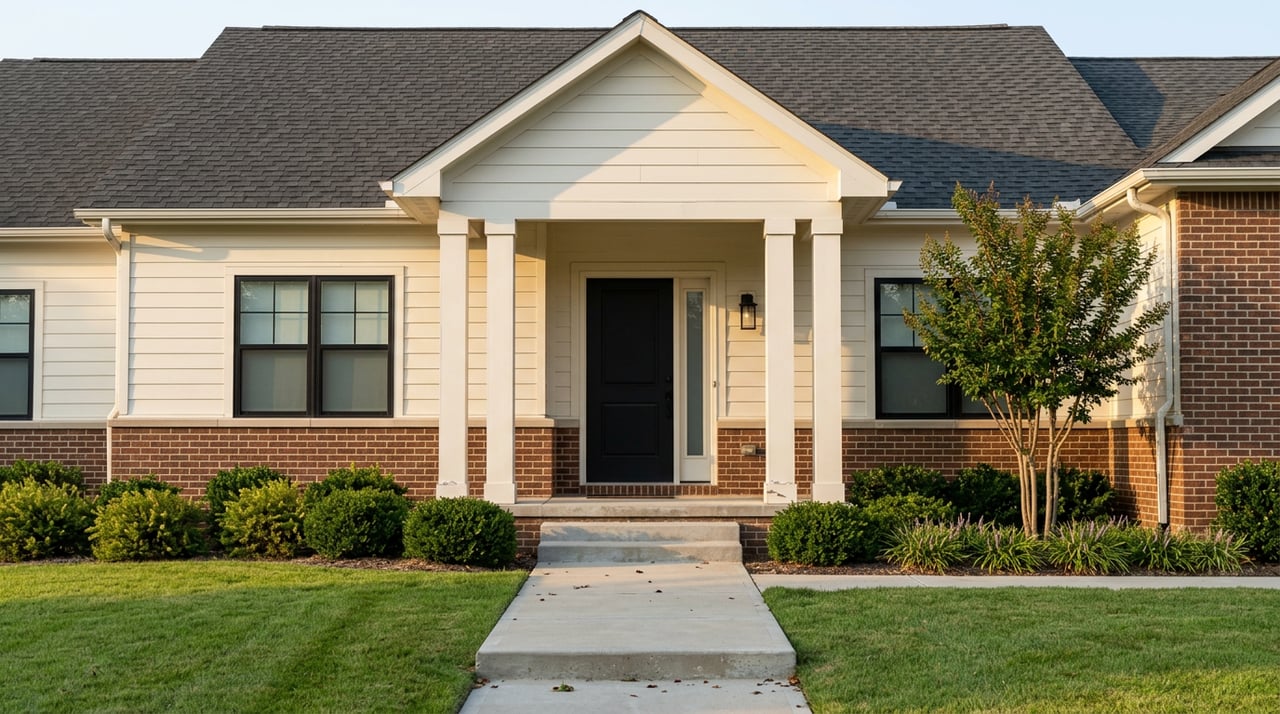
McDonough New Construction vs Resale Prices Explained
Pull up two McDonough listings priced within a few thousand dollars of each other. One is a resale a few blocks off the historic square, three owners in, updated kitchen, mature trees in the yard. The other is a to-be-built home in a newer subdivision off Jonesboro Road, same square footage, same bedroom count. Most buyers glance at the two numbers, shrug, and pick based on which kitchen they like better. That shrug is the mistake. A resale price and a new-construction price are answering two different questions, and the difference rarely shows up in the number you see first.
When a resale seller in McDonough needs to move a house, the lever is simple. The list price comes down, the buyer sees it come down, and everyone negotiates from a number that's out in the open.
A production builder can't do that as easily. Cutting a subdivision's base price resets the comps for every remaining lot in the community and can undercut the family who closed on the identical floor plan two doors down last month. So instead of lowering the sticker, builders push the discount into financing. A rate buydown or closing cost credit lets a builder advertise a lower monthly payment without officially reducing the home's price, and the community keeps its stated value on paper. That's part of why incentive activity has stayed elevated even in stretches where builders aren't touching their base prices at all.
The incentives themselves usually take one of a few forms:
Each of these changes what you pay every month or what you bring to the table at closing. None of them changes the number printed on the listing sheet. That's the entire point.
McDonough isn't short on new construction to compare. National new-home trackers currently count more than 20 active communities in the city, split between roughly five dozen townhome floor plans and well over a hundred single-family plans, with dozens of finished homes ready for a quicker move-in than a to-be-built contract allows.
The price floor and the price ceiling inside that group are further apart than most buyers expect:
| Community | Builder | Advertised Starting Price |
|---|---|---|
| Villages at Walnut Creek | Smith Douglas Homes | $191,900 to $223,105 |
| Kendall Grove | Starlight Homes | Mid-to-upper $300s |
From there, the product climbs. Trinity Park, built by DRB Homes near the Publix, Kroger, Target, and Henry Town Center corridor off I-75, is known for four-sided brick exteriors and floor plans that often exceed 3,000 square feet. DRB Homes also has Bowers Farm in the mix, mixing townhomes and single-family plans with the same brick-forward exterior standard. D.R. Horton's The Gates at Pates Creek adds a gated entrance, a pool, and a cabana to estate-style plans near the Jonesboro Road retail corridor. Pulte Homes has its own community, Hawthorne Ridge, built around resort-style shared amenities.
None of those four communities publish a real-time price sheet the way Villages at Walnut Creek does, but the pattern is clear enough without one: "new construction in McDonough" isn't a single price point. It's a range that starts in the low $200s and climbs well past the entry tier once you add square footage, brick, and a gated pool.
Here's where the comparison gets harder, because the "market price" you're benchmarking against depends entirely on which tracker you open.
| Source | What It Measures | Figure | Time Window |
|---|---|---|---|
| Zillow (Home Value Index) | Typical home value, all tiers | $336,835 | Updated through June 30, 2026 |
| Redfin | Median sale price, actual closings | $314,000 | Three months ending May 2026 |
| Resideline | Median closed price, actual closings | $364,017 | Trailing six months, as of July 2026 |
That's a $50,000 spread depending on which number you screenshot. None of the three is wrong. They're measuring different things. Zillow's figure is an index built from estimated values across the entire housing stock, not just homes that sold. Redfin's number is a raw median of actual closings over a rolling three-month window, which means it moves with whatever mix of homes happened to trade in that stretch. Resideline's median covers a longer six-month window of closed sales, which smooths out some of that month-to-month noise but still reflects whatever inventory closed rather than what's currently priced to sell.
One data provider that tracks closed McDonough sales put the underlying problem plainly: the gap between an asking-price median and a closed-price median doesn't mean sellers are universally cutting prices by that amount, it usually means today's for-sale inventory is a different mix of homes than the ones actually trading. The lesson for a buyer is the same regardless of which portal you're staring at: anchor to closed comps, not to whatever number happens to be advertised right now.
Resale price per square foot gives a cleaner anchor. Over the three months ending May 2026, McDonough's median sale price per square foot sat at $130, down 19 percent from the year before. That figure, paired against a new-construction floor plan's advertised base price and its actual finished square footage, is a far more honest comparison than list price against list price.
Once you accept that a builder's incentive-adjusted price and a resale seller's negotiated price aren't quoted the same way, the fix is to stop comparing sticker prices altogether and compare two other numbers instead: what each option does to your monthly payment, and how much cash you need at the table.
Take the builder's stated price, subtract the dollar value of whatever rate buydown or credit is on the table, and run the resulting payment through a lender the same way you'd run the resale property's negotiated price. Do the same cash-to-close math on both sides, factoring in what a closing cost credit actually covers versus what you'd pay out of pocket on the resale side. Those two figures, payment and cash to close, tell you more about the real deal than either listing's headline number ever will.
One caution worth building into that math: sometimes the cost of a rate buydown or credit is baked into the home's price rather than layered on top of it. You get the advertised lower rate, but you're financing a higher loan balance to pay for it. That's not automatically a bad trade, but it's a different trade than a straight discount, and it's worth asking the builder's sales office to show the math in writing rather than taking the incentive at face value.
There's a second flag worth watching for on the new-construction side specifically. If a new build's incentive-adjusted price is still meaningfully higher than comparable resale homes nearby, even after you've subtracted every credit and buydown, that gap can mean you're financing amenities and finish level rather than paying for equivalent square footage. That's a legitimate choice if the gated pool or the four-sided brick matters to you. It's a costly mistake if you didn't realize you were making it.
If a builder covers my closing costs, am I automatically saving that full amount? Not necessarily. Some builders fold the cost of the credit into a slightly higher base price, which means you're financing a larger loan rather than pocketing a straight discount. Ask for a side-by-side breakdown, with and without the incentive, before assuming the credit is free money.
Does McDonough's current pace of sales give resale buyers any negotiating room? Some. Over the three months ending May 2026, McDonough homes were receiving roughly one offer on average and taking about 62 days to sell, conditions Redfin characterizes as not especially competitive. That's a market where a well-prepared offer on a resale home still has room to negotiate on price directly, which is exactly the lever new-construction buyers don't have.
The question isn't whether new construction or resale is the better category. It's whether you're comparing the two on the same terms. A builder's price and a resale seller's price are built differently, and the only way to know which one actually saves you money is to run both through the same monthly payment and cash-to-close math before you sign anything.
If you're weighing a DRB Homes floor plan against a resale a few streets over, or trying to figure out what a rate buydown is really worth against a straight price negotiation, Cyndi Williams at True Atlanta Real Estate can walk through both sides of that math with you. Schedule your free consultation and get a straight answer before you're standing in a design center signing off on upgrades.

I listen to your needs and utilize the best information and market data to guide, inform and equip you with the best negotiation position. From the first phone consultation, I will listen intently and ask appropriate questions to ensure I understand your expectations throughout the process.